Everything you need to know about recycled paper
Printed materials via ‘Printed materials’ and a Paper selection, which stretches into infinity. One material always stands out: Recycled paper. We usually associate the term ‘recycling’ with Sustainability and environmental friendliness. But What is recycled paper? Really? How is it made? And is it really environmentally friendly? We’ll explain everything you need to know about recycled paper.
What is recycled paper?
Recycled, eco-friendly or ‘green’ paper is produced entirely from waste paper. The waste paper is dissolved in water, breaking it down into individual fibres. A ‘de-inking process’ is used to remove any existing ink and decolourise the fibre pulp. To produce paper that is as light in colour as possible, the fibres are bleached and then pressed into new paper. In this way, waste paper is given a new lease of life under the name ‘recycled paper’.
What are the characteristics of recycled paper?
It is a myth that recycled paper has a grey or even brown tint. The waste paper is cleaned in such a way that the newly produced recycled paper takes on a natural white colour. It also impresses with its very high opacity. Good opacity means the paper is good at blocking light, ensuring that the print does not show through the paper, which makes it possible to print on both the front and back without any problems. Furthermore, the recycled paper offers excellent print quality and absorbs ink richly. The paper is available in various grammages and is suitable for use in all sectors, including the food industry (packaging, labels, etc.). To the touch, it feels Printed materials made from recycled paper High-quality and sturdy.
Features at a glance
- Natural white shade
- Very high opacity (light-blocking), double-sided printing available
- Very high print quality available
- Rich ink absorption
- Various paper weights available
- High-quality and sturdy feel
- Used in many sectors, including the food industry
What are the advantages over conventional paper?
1. Environmentally friendly
As recycled paper consists of 100 per cent waste paper, no trees need to be felled to produce it. Consequently, forests are preserved and biodiversity remains unaffected. This helps to preserve the habitats of animals and plants, which in turn also helps to protect the climate. As there is no deforestation, this also avoids any additional environmental impact. In summary: Recycled paper therefore actively contributes to environmental protection.
2. Healthier
The combination of recycled paper and toxic chemicals or additives simply doesn’t work. Here, you can rely on certifications and, in most cases, be sure that no hazardous substances are present. Furthermore, recycled paper requires around 20% to 25% less CO2-Emissions equivalent to those of freshly produced paper.
3. Water & Energy Saving Champion
The recycling process not only produces fewer emissions, but also uses less water and energy. Compared to virgin paper, recycled paper uses up to 70 per cent less water and 60 per cent less energy. Using recycled paper therefore conserves valuable resources.
4. Less waste
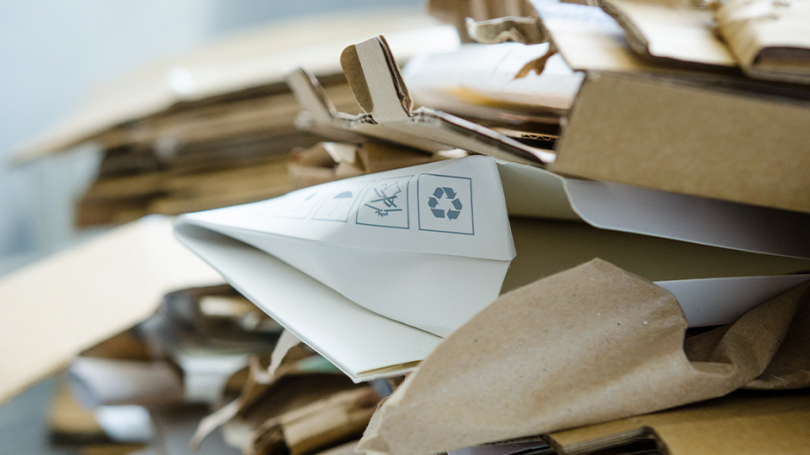
We all know how much waste paper and cardboard ends up in the recycling bin every day. In the production of recycled paper, ‘waste’ is taken and transformed into something new. This helps to reduce waste paper accordingly. What’s more, recycled paper can be recycled up to five times.
5. Every little step counts
By actively championing environmental protection, you set an important example. The decision to print your own materials on recycled paper enhances your brand and also improves your image. Sustainability and environmental protection are values that every company should champion, and these can also be highlighted visually and through the feel of the materials. Remember, every single step counts towards creating a world in which our descendants can also lead a pleasant life.
What are the disadvantages of recycled paper?
Whilst recycled paper has a number of advantages, it also has one disadvantage: due to the manufacturing process and the effort involved, it is still more expensive than conventional paper. Although the manufacturing process for standard paper requires a fair amount of resources, it is generally cheaper than that for recycled paper. This is because sourcing and recycling waste paper, as well as all the associated steps, incur additional costs that need to be covered. This also affects the price of recycled paper. Consequently, printed materials on recycled paper are still slightly more expensive than those on standard paper.