7 tips for designing posters
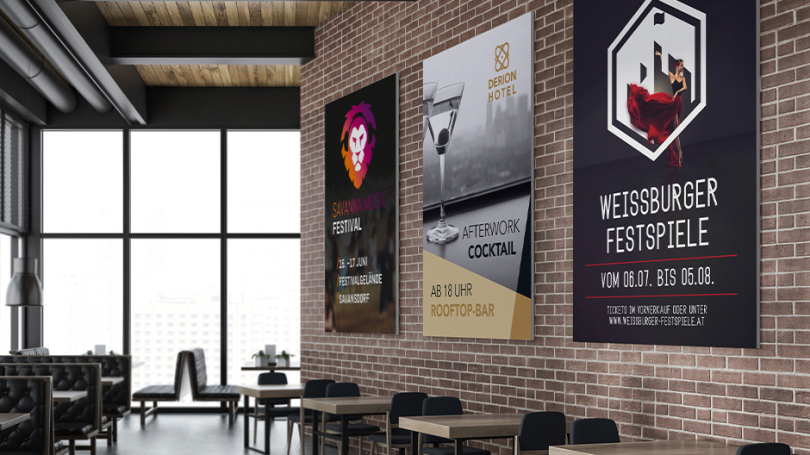
The range extends from small Advertising poster up to 16-sheet poster. They can be used both indoors and outdoors and share a common goal: to inform! And in a striking way.
But enough of the wordplay – let’s get to the important stuff. After all, time is precious.
Why?
You can find out more in our Tips on designing posters. After all, you’ll surely want to maximise the chances of your poster being noticed.
1 | Keep it short and simple!
What do you think?
How much time do people spend looking at your poster, which you’ve created with such care?
10 seconds? 1 minute?
Take a moment to observe yourself when you’re out and about in your car or strolling through town. How long do you let the poster make an impression on you? Be honest!
Whatever you’re designing or commissioning!
Always remember: you’re short on time!
On average, people spend a maximum of 1.5–2 seconds looking at posters in their surroundings. You might think that’s a long time? Of course, if you’re at the gym and the trainer tells you to hold the squat for 2 seconds longer, then yes, 2 seconds does feel like a long time. But in everyday life, 2 seconds is practically nothing.
So, it’s all about those 2 seconds. Make the most of them!
2 | A brilliant idea!
Showcase your advertising message in an eye-catching way. Don’t get bogged down in too many details – the main message must be clear at a glance. You’ve got a promotion: showcase it prominently! You want to publicise an event: display the name, date and venue. You’d like to showcase a new product? Then show the new product and a snappy headline.
Don’t make the mistake of cramming too much information onto it. Create an initial impact to draw attention to yourself, your products or your services.

3 | Large font and minimal text
Get your advertising message across concisely. Avoid lengthy explanations. Do not try to include additional promotional messages using elements such as buttons. The A question worth asking: Where does the viewer look first? Ideally on your Prominently displayed message, which you wish to convey.
This is best achieved with an image. A picture is worth more than 1,000 words. As old and hackneyed as this saying may be, it holds true forever, especially when it comes to posters. Back up your advertising message with an image that’s guaranteed to hold people’s attention for more than two seconds.
There are two key factors, which you need to bear in mind. On the one hand the distance, from which your poster is viewed, and the size of the individual elements such as typeface & co. An element measuring 30 cm looks too large on an A4 poster, whilst it virtually disappears on a 16-sheet poster.
4 | Technical tips
There are a few common mistakes that are frequently made when designing posters. One of the main mistakes is the Creation of the poster in a format that is too small, e.g. a design is created in A4 size in a graphics programme and then ordered in A0 size from the print shop. This can result in images with insufficient resolution becoming pixelated or credits being cropped. Incidentally, you should bear the final format in mind whilst designing, as, for example, font sizes adjusted to the viewer’s distance must be specified, and some design decisions depend on the final format.
Wherever possible, use vector files, as these can be scaled to any size. However, There’s no rule without an exception: whilst an image resolution of 300 dpi is absolutely essential for small formats, a resolution of 60–100 dpi may sometimes be used for a sheet-sized poster. The reason for this is, once again, the viewing distance, which makes this possible.
Don’t forget to allow for bleed…so that credits, logos and the like don’t suddenly disappear during printing. You can always find the exact dimensions listed directly with the product on our site.

5 | Find a suitable printing company
If you Special requests and requirements If you have these requirements, you shouldn’t settle for a run-of-the-mill copy shop. Spot colours, spot varnish and embossing are just a small selection of all the finishing options that a professional printing company has to offer. After all, even the most beautiful poster design cannot reach its full potential if printed on the wrong paper. Here at druck.at, we’re happy to help you with all sorts of questions relating to the Design, printing and materials for your poster.
6 | Choosing the right paper
Depending on where and for what purpose you’re using them, you’ll be spoilt for choice Choice of paper types. You should be able to answer the following questions.
- Where will the poster be displayed? Indoors or outdoors?
- What size should the poster be printed in?
- What print run do you need?
You might also like to Design a high-quality poster, then consider whether fabric posters or cellophane-wrapped posters might be an option for you.
7 | Stay positive
A poster featuring positive or amusing message evokes pleasant feelings in the viewer. This Pleasant feelings stay with you for longer and fosters positive associations with your brand. This can be achieved both through well-crafted messaging and through the use of colours and images.
Make a lasting impression. We all have a short attention span in our hectic day-to-day lives. Of course, it’s tempting to cram in this or that bit of information. But in reality, you only have a few seconds – please excuse us for harping on about it.
We know from experience that posters are often crammed full of information – whether due to budget constraints, current promotions, etc. But the best posters, the ones that stick in the memory, provide as little information as possible and present it skilfully.