Offset printing: a success story

Whether for books, newspapers or packaging – offset printing has been in use for more than a century one of the most popular Printing processesn, when it comes to large print runs works.
But where does the name come from, and how does the process work? Find out why offset printing remains so popular to this day in this article:
How the time was right
The history of printing has its origins with the Egyptians, Greeks and Romans, who used palm leaves and stone tablets for printing.
In the 8th century, for example, people in Asia carved entire pages into a wooden printing block, thereby paving the way for letterpress printing.
Arguably the best-known pioneer in the history of printing is Johannes Gutenberg. He developed in 15th century movable type. These mirror-inverted lead type made it possible to work more efficiently and print larger quantities.

Lithography in the 18th century
In the 18th century Developed Alois Senefelder Another printing process whose principle forms the basis of modern offset printing: lithography.

In this process, Senefelder applies the image to be printed, in mirror image, to a stone slab using oil-based ink. He then treats the areas of the stone slab that do not contain the image with an acidic solution. The oil-based ink and the acidic solution penetrate the pores of the stone and remain there even after the stone has been washed.
Whilst the acidic areas of the stone absorb water and repel grease, the opposite is true of the areas treated with ink: there, the stone absorbs ink and repels water. If printing ink is now applied evenly across the entire stone, this oil-based ink is repelled by the acidic areas and is only absorbed in the areas treated with equally oil-based ink. Through Pressing the stone onto the paper This is how the desired print layout is created.
Offset printing – How does this printing process work?
Ira W. Rubel and Cašpar Hermann drew on the principle that oil and water repel each other in their developments of Early 20th century They also made use of this. They saw it as a way of indirectly transferring the print image and preserving the printing plates.
Here’s how it works: in offset printing, the printing plate does not come into contact with the paper. Instead, there are rollers in between – known as rubber blanket cylinders – which enable the ink to be transferred indirectly. This is where the Naming: In English, ‘offset’ means ‘set apart’. It refers to the print impression.

Flexibility leading to precision – the advantages of offset printing
However, when it comes to Offset printing Not only do the blanket cylinders protect the printing plates, they also have another Advantage:
Have you ever touched the rough side of sandpaper with your hand and looked at it very closely? Sandpaper is rough because of its small grains. The smaller these grains are, the less space there is between them and the more grains can be used. This is referred to as a high grit. In this case, the density is greater and the surface is smoother.
When we look at a standard sheet of A4 paper, the surface appears completely smooth. Yet even this paper has tiny irregularities. If we press a hard stamp onto a sheet of paper and then lift the stamp away, we can therefore see a slight blurriness on the paper if we look closely.

The situation is different when, instead of a hard material, a soft, flexible material – such as the rubber blanket – comes into contact with the paper. The rubber blanket moulds itself to the pores of the paper, thereby producing a finer print image. Thanks to this principle, offset printing is regarded as one of the most precise printing processes.
This is where colour comes into play – offset presses at Druck.at
Today, druck.at works with two Heidelberg XL Speedmasters, to ensure precision and speed six million sheets in just one month to print.
Each of the colours (cyan, magenta, yellow and key black) is housed in a separate printing unit. Printing plates coated with water are clamped into these printing units.

The coloured areas of the printing plate repel the water, whilst the non-image areas absorb it. Ink is then applied to the printing plate, where it adheres only to the image. The image is transferred to the rubber blanket via a series of rollers. The blanket cylinder then prints onto the paper.
The paper passes through all four printing units in succession, which is how it is printed.
Photos in offset printing – how does it work?
But that’s not all: if you zoom in on a photo, you’ll see the many tiny pixels and dots of colour that make it up. To print such a photo using offset printing, many tiny dots of ink must therefore be printed side by side. To do this, druck.at creates screens that determine how large the dots are and how far apart they are from one another. The overall image formed by these dots then produces the desired photo.
Better safe than sorry thanks to digital quality control
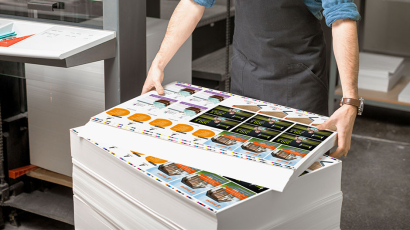
At druck.at, sensors in the printing press take over the Quality assurance. They scan the colours on the so-called print control strip throughout the entire printing process, thereby ensuring consistently high colour quality. This saves druck.at both time and materials.
Digital quality control, chemical principles and sophisticated material blending – its characteristics make offset printing the most precise and high-volume reproduction method available today – and rightly so.
Have you now acquired a taste for offset printing? Let the The druck.at team Plus professional advice!